Saturday, August 6, 2005

Life on the Farm - Part 3

The Animal Farm


Our animal farm was located on a lower area of our farm land.  The land sloped towards a flat area which was about the size of 2 football fields.  (See: Farm-view)  Beyond this was a ravine at the bottom of which ran a stream in a northerly direction.  On the opposite side of the ravine was a hillslope planted with rubber trees which probably dated back to the time of the Straits Settlements. 


During the Emergency after the Japanese occupation, different groups of people would show up at the farmhouse for some food or just a rest and a chat with my father.  One day, while Pa was standing by the front door, he noticed a group of armed men in jungle green uniforms carefully creeping through the bushes towards the farmhouse with rifles in their hands.  My eldest brother was then about a year old.  He was playing outside the door.  Pa calmly walked out the door and picked him up.  The armed men turned out to be British soldiers.  They lowered their guns after they checked Pa's identifications.  Then they sat down, relaxed and even played with the baby.  Pa of course did not dare to tell them, even if he could speak English, that another group of armed men has just left the place a few hours earlier.


It was in this house that my two elder brothers and elder sister were born before Pa built our second house.  It was later converted into a material store and cooking house where the food for the farm animals were prepared. 


Woks


We had two huge woks.  One was cemented into a stove with a wall 1 foot thick built around it to about 4 feet high.  It resembled a huge cooking pot with a hole measuring 2 by 2 feet for putting in fire-wood at the base, on a lower level.  The other wok, slightly smaller was cemented on a stove beside the first.  Both stove openings faced one area where we could feed in fire-wood from a wood stack.  The big wok was for cooking a mixture of cut-up banana trees, yam plants, water hyacinths, tapioca, red beans, kaoliang, copra cake and corn.  The red beans, kaoliang, corn, and copra-cakes were bought from a stock-feed supplier, while the rest come from our own farm.  The red beans were imported from China.  They're the same red beans that restaurants now use for preparing ice-kacang and no longer considered animal food.  They've become too expensive to be fed to animals. 


Sometimes we had to buy the tapioca from neighbouring farms.  It used to cost 3 cents a kati (a kati is equivalent to 600 grams). The whole gang of us would go over to the place with all our tools, dig up the tapioca and load them into a large gunny sack and transport them back to our place on a bicycle.  We couldn't ride it of course.  It was too heavy, at least 100 katis.  Pa would push it and some of us would stabilise it from behind. 


Most of the local ingredients had to be cut into pieces before cooking.  Once in a while we get careless and cut our own fingers.  I once chopped off the tip of my left index while cutting tapioca.  I yelled out when I saw my finger tip on the chopping block and my blood dripping.  My mother rushed me back to the house and applied some ointment and wrapped it up with a strip of white cloth.  I blacked out for a moment.  Fortunately, years later, I could still learn to play the guitar, but the last string often had a dead sound to it.  The second time I cut my own hand, it was quite close to the knuckle.  Luckily, it wasn't too deep, but the scar is still there.  I was then chopping the hyacinths. 


Number 7 brother was left-handed.  But our parents got him to write with his right hand.  One day, he cut his right thumb leaving only a small bit of his nail intact.  He was cutting tapioca, holding the knife with his left hand and the tapioca in his right.  My mother had to take him to hospital.  They gave him a few stitches.  He had no choice now but to write with his left hand.  Luckily, he had only just started schooling.  Otherwise, it would have been difficult for him to catch up.


The banana trunk had to be sliced into thin, discs-like pieces, then chopped into tiny cubes.  The thinest disc we could managed to slice was about 4mm.  The slicing knife was shaped like a cresent and had a hollow handle on either end and the blade with its cutting edge on the inner side, had to be honed until it was razor sharp.  Then we attached a piece of split bamboo, shaped to fit into the handles straight across the blade.  This flat piece of bamboo worked like a jig to limit the thickness of the disc.  It took about an hour to slice up a 6 foot trunk.  We usually had to cut up 3 banana trunks for each cooking session.


Farming was mostly heavy work.  We had to do this gathering, cutting, chopping and cooking work every 3 or 4 days to feed about 100 - 120 pigs.  What we cooked in the big wok was all vegetarian and meant for the pigs.  In the smaller wok, we cooked fish, shrimps and a lot of other sea food which my father bought cheaply from the market.  These were the unwanted catches that fishermen could not sell for human cosnsumption, so they become animal food.  These were cooked and mixed with milled oats, corn and other cheap grains and fed to the chickens and ducks and a portion of it mixed into the pig food.  We didn’t rear egg-layer chickens on a large scale until much later, when I was schooling.


For planting, the tapioca tree had to be cut into short lengths of about 150mm and planted in rows of dug up and loosened earth and formed into long beds raised to about 500mm high. Holes were dug near the base on one side of the bed about 600mm apart and the cut tapioca tree was dropped in each hole in a right-angled position to the bed and covered with soil.  When the first leaves started to appear, manure, usually pig dung was poured on top of the beds.  Tapioca took about 8 - 10 months to grow.  Harvesting was an equally tough job.  The stump and the roots were pulled from the ground after we cut down the trees.  If the ground was too hard, especially during the dry season, a pick was used to dig in at the base of the stump and the whole bunch was levered out.


The tapioca tree consisted of 1 - 3 main trunks sticking up from the ground.  Below the ground the tubular roots grew up to about 300 - 400mm long and each root was 40 - 60mm in diameter, tapering off in a pointed end.  Each tree yielded about 5 - 6 units of tapiocas of normal size, and some of various sizes, some even as small as peanuts.


Banana trees came from the grove or “payoh” behind the pig-stys.  Beyond that was a ravine of about 6 meters deep and 10 meters wide.  There was a stream at the bottom of the ravine.  The water ran clear and fresh during good weather and it formed part of our playground in the afternoons when our father went out for his daily trip to the local coffeeshop.  We would catch shrimps and lots of small colourful fishes called guppies.  Once we almost caught an eel, but it got away.


This 'payoh' with its loose sandy soil also yielded lots of earthworms.  We used to dig them out from the soil and fed them to our ducks.  Sometimes accidents happened.  One of us would be digging with the hoe while the rest would grab the worms before they disappeared back into the earth.  Once while I was digging 2nd brother quickly bent down and tried to grab a worm.  The hoe landed on his head instead.  Seeing a gash on his scalp and blood flowing, we rushed him back home.  Ma quickly applied some ointment on the wound and covered it with a pad cut out from a piece of white cloth.  Most probably the scar is still visible.


Pig farming required a lot of water.  We used to wash the stalls and bathe the animals by scooping the water from the tanks with metal pails and splashing them on their bodies.  Then we had to throw the water in such a way that it went like a torrent to flush out the solid waste.  When our source of water from the hills became too unreliable, Pa installed a diesel engine pump on the edge of the ravine to pump up water from the stream.  This made our life a lot easier.  We now used hoses connected to the pipes and spray or shoot the water as we liked, depending on what we needed to use it for.  We fitted a short length of metal pipe to the end of the hose.  To spray, we stuck a forefinger in front of the nozzle to disperse the jet of water coming out.


We took care not to let our pig waste water flow into the stream.  We had a special pond built to contain the solid waste, while the water flowed into 2 huge ponds where water hyacinths grew.  We harvested these hyacinths from the ponds, broke off their roots and loaded them into specially made baskets.  We had to wade into waist-high water to do this job in the hot afternoons.  The temptation to splash around or swim in the murky water was always there.  As always, after this job was done, we would stink like the waste pond itself.  Sometimes even a thorough wash with fragrant soap couldn't rid us of the smell.  My brother and I would put a long pole through one of these baskets and carry it to the “cooking-house”.  Usually we had to harvest about 2 or 3 baskets of them for each cooking session. 


The pig waste pond usually looked very solid on the surface.  Because of the pig's vegetarian diet, the waste was mostly fibrous and light material.  Thus they stay afloat while the liquid became hidden beneath.  I'm not sure how deep it was.  But we never made the mistake of stepping on the surface.  You could end up in pig waste up to your head.  Pa made a fence around it just to make sure we wouldn't fall in by accident.


Yams grew abundantly in the shallow drains flowing to the hyacinth ponds.  The stalks and leaves were also cut and cooked together with the rest of the materials.  Growing alongside the yams were kangkong which I used to harvest by cutting the newly grown stalks and tying them into a bundle of about 4 - 5 kgs which my father sold to retailers at the morning market.  It was a boring, routine job and I was the only one given that task and I dreaded it because I had to do it alone. 


Another dreadful job of which I was given the sole responsibility was scraping off the chicken droppings from our hen-house.  These egg-layers were housed in rows and rows of wire-mesh cubicles.  The hen stayed in this cubicle big enough only for her to turn around to eat from the food tray or drink from the water trough, throughout her egg-laying life.  The bottom mesh on which the hen stood was made to slope outwards at an slight angle so the the eggs can roll out as soon as it was laid.  Most of the droppings were wet and the smell was like stink-bombs that party gate-crashers loved to use in those days.  As soon as I finished that job, I had to go for a complete clean-up bath and change of clothes.


...more to come....

Tuesday, August 2, 2005

Life on the Farm - Part 2

The Farm-House


Our farmhouse stood on a considerably high ground facing north, in the middle of a valley, (about a hundred meters west of the present Tunku Abdul Rahman College) with hills stretching from the north sea coast of Penang Island, runs southwards and round towards the west and then northwards again to where they end near the sea coast.  On the north-east stands a lone hill* joined to the eastern hill range by a shoulder, where the Guillemard reservoir is located.  There is a winding road through here from Tanjung Tokong which we always used as a short cut.  Those days when there were less traffic going through this pass, we often heard of spooky tales from those who used that road at night.  But if you were to travel via the coastal road, you could consider having reached Tanjung Bungah as soon as you get pass the Penang Swimming Club.

*This hill, originally called “Jaga Sua”*,was renamed "Pearl Hill" and was developed in the 1980s to hold some bungalows and apartments, perched precariously on its slopes.
 “Jaga” is Malay word meaning Guard or Lookout.

 “Sua” (pronounced with nasal tone as in ‘sign’) is Hokkien or Teochew for Hill.


Tanjung Bungah then was a haven for fishermen, rubber tappers and farmers until the 70s.  Eventually the rubber trees grew old and expired and the estates disappeared.  A granite quarry was opened up in 1959 at the foothills at the back of the valley.  The narrow dirt road that ran pass our house was widened and covered with loose stones for the stone laden trucks to run through.  And life has never been the same after that.

Our house was built on a spot slightly off a ridge which had almost tapered off into flat land.  According to father, a house should not be built on a ridge of a hill as the description for a ridge in Chinese means 'dragon of the hill'.  Imagine sitting on the back of a dragon.  There would be no peace in the house.  This was illustrated by our neighbor's house whose farm was behind ours.  His house was standing directly on a ridge.  True to the legend, the family members were always fighting with one another.  But of course, they had reasons for their turmoil as the guy had two wives and more than a dozen children of various ages, all crammed into a little 3 room farmhouse!  We were told, they used to sight strange beings in their house at night.  But we didn't know for sure if that was the cause of all the noise we sometimes heard in the evenings coming from their house which is about 200 meters from ours. 


The house in which I was born was actually our family's second house.  The first one was located across the narrow country road on a lower slope facing north-west.  There was a flat area here before a deep ravine at the bottom of which ran a stream which would swell into a raging river during heavy monsoon rains.  This house was converted into a store cum cooking-house where all the food for chickens, ducks and pigs were prepared. 

Our home was a single-storey, 3-room ‘bungalow’ with wooden front and zinc sides.  The floor was concrete with a very smooth finish.  The roof cover consisted of nipah (attap) leaves folded over and stitched together on a stick.  (they come pre-stitched).  Each piece measures about 1 meter long and every piece was tied to the framework of the roof from the lowest edge upwards and lined in a row to the apex at the top, each one overlaying the previous at intervals of about 75mm.  The next row would start again at the bottom edge and with the ends ovelapping the ends of the pieces in the first row.  The tying process would continue until the whole roof was covered.  The apex was then covered with 400mm wide strips of zinc sheets folded slightly in the middle to form the apex. These are tied down with pieces of steel wire.  The attap roof offered a very good cover and was cool during the day and noise from falling rain was muffled (as compared to zinc roofs which gave a deafening beating noise each time it rained, so much so that we had to shout when talking to each other.  This, we found out when we changed the roofing years later.) 

We had a porch right across the front which we called the 'five-foot-way'.  The family altar was located at the living room facing the front door.  This was required by tradition.  On our altar sat the 'Tua-Peh-Kong'.  In front of the altar we placed a square table where we would do our homework after school, hold discussions after dinner or where Pa would calculate our profits and losses from the farm.  I used to watch in fascination as he flicked the beads back and forth on the abacus and mumbled to himself and wrote the figures on the bills.  When he had done with the arithmatics he would hang all the bills stacked together onto a nail in the wooden wall.  From snatches of conversations between him and Ma, I gathered that we were somehow getting more losses than profits.  I would believe the profits that we made were probably spent feeding and educating our little army.

Before our 7th and 8th brothers came along, six of us children occupied the front room which was a raised platform covering the whole room.  We slept on straw mats, using oat bags sewn together for blankets.  Mattresses were a luxury reserved for our parents who occupied the 2nd room, while the 3rd room behind the family altar was occasionally occupied by my grandmother, who moved from house to house among my father’s two elder brothers and a younger sister.  If Ma had a story to tell Pa, or they decided to take their arguments to bed with them, we would have a problem trying to get to sleep.  There was no ceiling.  The dividing wall was about 4 mm thick hard-board and eight feet high.  It was quite a mental torture for light sleepers like me.  Grandma also had a mattress to sleep on.  I was about 12 when grandma passed away.  I then moved to her room, slept in her bed and used her mattress. 

Behind grandma's room was our kitchen/dining area.  The wood-burning cooking place with three built-in stoves was constructed out of concrete and bricks.  Under this contraption was a hollow base for storing the ready chopped, split and dried woods.   Naturally, our kitchen walls and roof became blackened over time from all that smoke billowing out whenever we started a fire.  To start a fire we used to burn pieces of paper dipped in kerosene.  Sometimes we ran out of kerosene.  We then had to use a hollow piece of bamboo to blow against the fire to get it to burn faster.  At first we couldn't get the knack for doing it right.  Instead of blowing we got short of breathe and sucked in and ended up coughing.  Wood-burning stoves later became out-of-style when made-in-China charcoal stoves were introduced to us in the early 60s.  That ended our problem of finding, cutting and chopping fire-wood.


On the other side if the dining and cooking area was the washing area.  There was a concrete water tank with half of it enclosed with zinc walls for the bathroom.  We used old Milo tins to scoop up the water for bathing and washing.  Later when plastic hoses were available, we used a piece of plastic hose to siphon out the water for washing clothes where continuous flow of water was usually required.  As kids, we were afraid of the dark bathroom.  So we chose to bathe outside until we were old enough to feel self-conscious, especially when we had visitors who liked to sit at our dining table and chat with mother when she was cooking.

When we started growing up and had two more additions to the family, Pa decided to extend the kitchen.  He had the old wood-burning stoves knocked out and relocated the water tank and bathroom further back.  We then had a bigger dining room and kitchen and another room where the washing area and old bathroom were.  It was this room I stayed in when I got married.

Our toilet was a pit latrine located across the road.  Those days only pit latrines were used in the countryside.  We dug it to about 6 feet deep.  But eventually it began to fill up.  Usually it wasn't our excrement that filled it up.  The damage was often caused by moles burrowing holes into the ground beside the latrine.  During heavy rains water flowed into the holes filling up the latrine with muddy water.  Our problem was when we needed to 'go' during the night.  Most of us dared not go outside alone.  So we needed to call up some escorts.  If you feel lazy and refused to provide the escort service when required, there was always the threat that next time if you need someone to escort you, you'd not find any volunteers. 

So, there you are squatting inside the dark toilet doing your thing, while the escorts stand outside chatting or stamping their feet chasing away mosquitos or keeping very quiet until you thought they had sneaked away.  You had to keep calling out to make sure they had not deserted you.  Sometimes the more courageous of us would start telling ghost stories and the rest would try to shut him up.  Another problem was trying to make sure we cleaned our behinds properly in the dark using old newspapers.  Tissue papers were probably not invented yet.

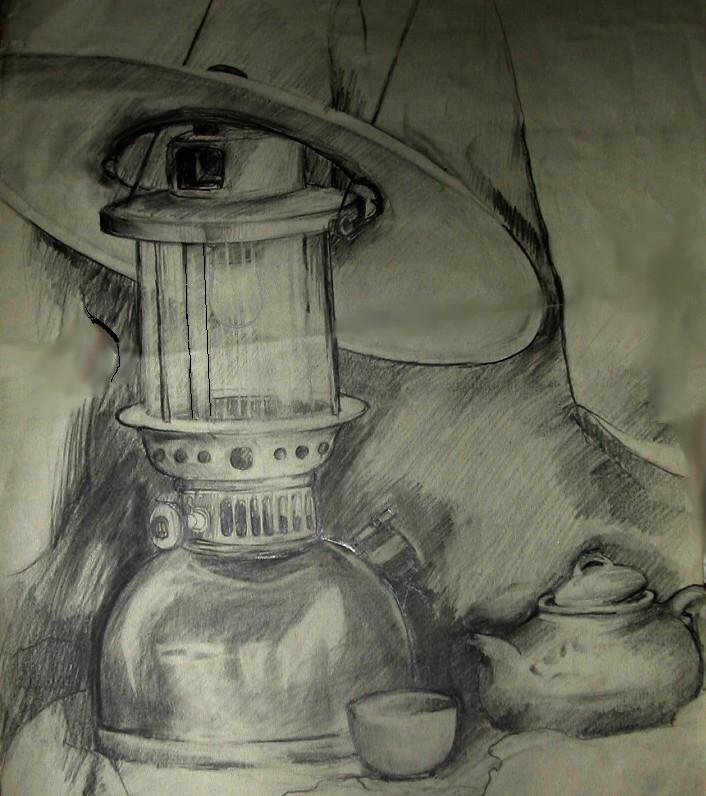
We didn’t have electricity until the later half of the 60s.  We had a pressurised kerosene lamp which was about as bright as our present 20 watt flourescent tube light.  But it was troublesome lighting it.  We had to pour in about 1 litre of kerosene into the chamber at the base, pump in air to pressurise it, then pour about 2 table-spoonfuls of spirit into a kidney shaped tray inside the lighting chamber which was surrounded by a cylindrical glass case, light up the spirit to heat up a cloth bag which was tied to a spray-head connected to a nozzle.  When the bag was properly heated, the pressurised kerosene was turned on to spray through the nozzle into the spray-head.  The resulting combustion transformed the bag into a luminous spherical shape which burned in a white continous flame until the combined kerosene/air supply was shut off.  After it was shut down, the bag remained spherical and can still be lighted up again and used as long as it remained unbroken.  But it was very fragile and any sudden drop or knock on the lamp would result in a broken bag, after which it had to be replaced with a new one.  


The responsibility of lighting the lamp started with Pa.  Then when he had enough of doing it everyday, he passed the job to my eldest brother.  Later, everyone had to learn how to do it.  Of course some of us were not as gentle as required and ended up breaking the cloth bag too often.
The nightly bedtime routine was the hissing sound of the shut down process of letting the compressed air out of the kerosene chamber.

Our water supply came from the foothills.  There used to be a stream flowing continuously with clear and fresh water, so clean you could drink it just by cupping it up with your bare hands.  Pa and some neighbors got together and fixed up about a kilometer of piping to get the water to our house and farms.  We enjoyed that luxury for a few years until the stone quarry started.  Then things started going downhill from there.  During rainy days we got a lot of muddy water from the pipes.  Most of the time the pipes were clogged up.  Pa had to go knocking on the pipes with a hammer trying to locate where the blockages were.  Sometimes he would open them up to find small stones jammed inside.  Now, during the dry seasons, whenever I hear a bird that goes "tang-tang-tang" in the evenings, I still remember Pa knocking on those pipes trying to get the water to flow again.

The stone quarry workers' quarters were located near the stream where we got our water supply.  Sometimes we were very suspicious about what we found in the water that flowed out from our taps.  Pa was terribly disappointed.  But life had to go on. 

Because our house was just near the road, we had to keep dogs around the house.  My favorite was a mongrel fathered by a German shepherd.  Nobody wanted him because he had a limp in the front leg.  Whenever anyone approached him he'd raise it like he was ready to shake hands.  We didn't have a name for him so we simply called him "kaokiah" (little dog).  He was great catcher.  I once saw him catch a rat which tried to escape through a hole in the fence.  He jumped and caught the rodent before it could get through the hole.  

I remember another dog we got from my cousin who lived on the main road about 3 kilometers away.  He was already full grown when we got him.  They called him Tiger.  We had to chain him up at first because he was not ready to accept us.  Later, we allowed him to run free once in a while, until finally we let him off the chain completely.  Then one day he went missing.  He went back to his old home.  My cousin brought him back to us.  We chained him up again for a while.  After a few times of this routine he got the idea that we were now his family.  But then, he still went back sometimes to his old home for a visit.  Along the way, he had to pass through hostile territories and probably had to fight his way through.  He would sometimes return home wounded and limping.  We also discovered why my cousin wanted to give him away.  We found him sleeping on top of the car one morning.  There were lots of scratches on the car bonnet.

We also had another dog which had the potential to be a killer.  He started off by attacking a neighborhood boy who was passing by.  Ma sent the boy to a clinic and paid his medical bills.  One day while I was tying him up after giving him his meal, he raised his head snarling and snapping his jaws.  It was only a split second but time was frozen at that moment.  I let go of him and stared at both my wrists.  There were 4 holes on each of them and blood was oozing out. 

It was some time before my wounds healed.  By then, my anger was gone, but I had not forgotten.  His aggression drove him to attack two more family members, Boon Kit and Chee Seng, before I decided to put him away permanently.  They were probably too young then to remember the incidences.  I took it upon myself to remove this menace from our home.  Jungle style.

We also had a cat which my maternal grandma gave to us.  She was black all over with white underbelly and white on one side of her face and her feet.  One day, she came back from her wanderings around the neighborhood looking very well fed.  We only realised later she was pregnant and gave birth to a few cute little kittens which were white all over except for the tips of their paws and their noses and tails.  Pa said they looked like Siamese Cats.  She probably had a Siamese boyfriend in the neighborhood.  We never knew who the boyfriend was or where he stayed.  Mother cat would not allow us to touch her babies.  She hid them among the bags of animal feed in the store.  Everytime she knew that we have found her hiding place, she'd move her babies somewhere else.   It was only when her kittens grew up and could run around on their own that she let us play with them. 

One day we heard mother cat calling out all over the place.  We couldn't find the kittens anywhere.  We assumed they were stolen by someone who thought they were pure Siamese.  But mother cat was never lonesome for long.  She attracted quite a number of toms who came and even stayed around for a while.  We were always getting more kittens than we wanted.  But the jungle seemed to take care of some over-population problems.  Mostly we don't know what happened, but some cats just disappeared and we never knew where they went.

Our home stood on this ground until the year 1996 when our # 7 brother decided he's had enough.  He had saved enough money to buy a new home and start a new life.  The construction company had started building the Tunku Abdul Rahman College nearby and they needed an access road to tranport material to the work site.  That road was to run right across our front yard.  It was also when severe water shortage, dust and noise pollution from the nearby quarry became too unbearable.  Termites, which I once thought I had taken care of permanently, had rebuilt their food supply routes all the way to the roof.  And there were incidences when he saw ghostly figures passing by outside the windows in the late afternoons or at night and dreamed about them telling him to leave the farm! 


Stay tuned, folks....